
Daniel Petrov | November 4, 2026 | Car Accident, Personal Injury
Fault in a T-bone collision in California is rarely as clear as it seems because both drivers almost always claim the other ran the red light or failed to yield, and without objective evidence, insurance companies may attempt to shift blame onto you. What determines who is liable comes down to surveillance footage, traffic signal timing data, witness accounts, and physical evidence at the scene, all of which disappear fast.
What determines who is liable in a T-bone accident comes down to the specific evidence available, how quickly it is preserved, and whether you have an attorney who knows how to build a case before the other side controls the narrative.
At Petrov Personal Injury Lawyers, Daniel Petrov has helped T-bone accident victims across San Diego County cut through disputed fault arguments and recover the compensation they deserve.
What Makes T-Bone Accidents Different From Other Collisions?
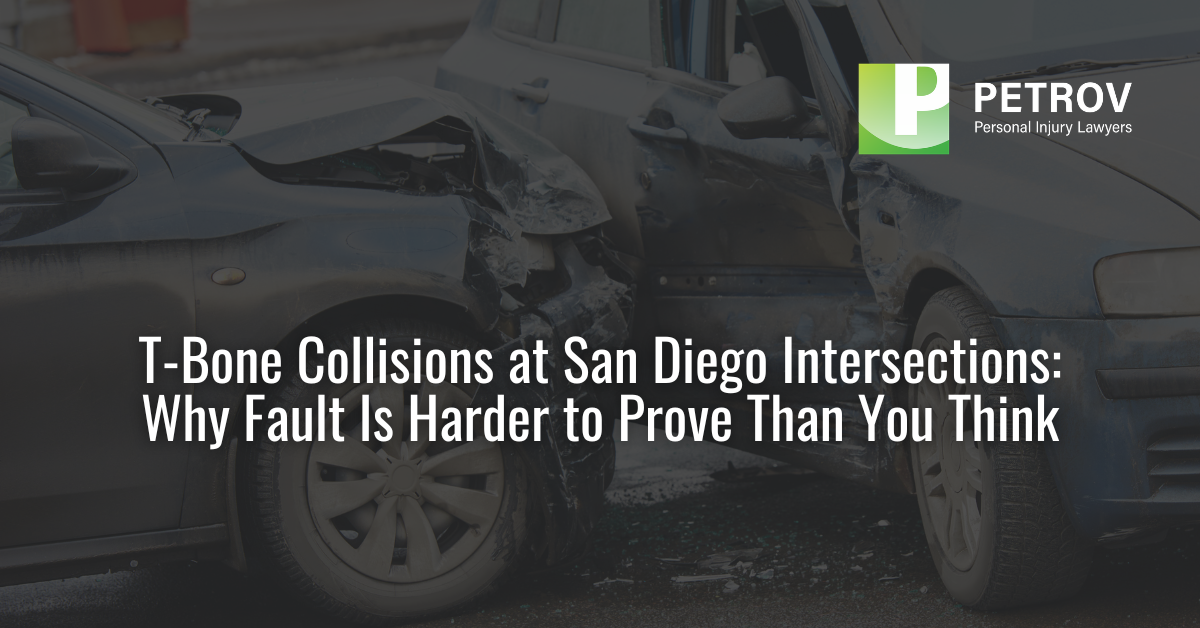
A T-bone collision, also called a side-impact or broadside crash, occurs when the front of one vehicle strikes the side of another, typically at an intersection. Unlike rear-end accidents, where fault almost always falls on the following driver, T-bone collisions involve two drivers who were both moving through the same intersection and both claiming right of way.
This creates a fundamental fault dispute that plays out in almost every T-bone case: each driver says the other ran the red light or failed to yield, and without clear evidence, insurance companies may try to split fault or assign it to the wrong party entirely.
The stakes are also higher in T-bone accidents because side-impact crashes are among the most dangerous collision types. The door panel offers far less protection than the front or rear of a vehicle, meaning occupants on the struck side frequently suffer serious injuries, including traumatic brain injuries, herniated discs, broken bones, and internal organ damage.
What California Law Says About Intersection Right-of-Way
California has specific traffic laws that govern who has the right of way at intersections, and violating these laws is the foundation of most T-bone fault arguments.
Traffic Signals
Under California Vehicle Code Section 21453, a driver facing a steady red signal must stop before entering the intersection and remain stopped until an indication to proceed is shown.
The only exception is a right turn on red or a left turn from a one-way street onto a one-way street, where the driver must first stop and then yield to all pedestrians and oncoming traffic before proceeding.
A driver who enters an intersection on a red light outside of these exceptions and causes a T-bone collision has violated this statute, but proving they did so requires evidence.
Left Turn Right-of-Way
Left-turn T-bone accidents are among the most disputed because the turning driver almost always claims they had sufficient time to complete the turn safely.
Under California Vehicle Code Section 21801, any driver turning left or completing a U-turn on any road must yield to all oncoming vehicles that are close enough to constitute a hazard and must continue to yield until the turn can be made with reasonable safety.
This rule applies at all intersections, signalized or not, and at entrances to private property and alleys.
Right of Way at Uncontrolled Intersections
At intersections with no traffic signals or signs, California Vehicle Code Section 21800 requires the driver who has already entered the intersection to have the right of way over an approaching driver.
When two vehicles enter at the same time, the driver on the left must yield to the driver on the right. At four-way stop intersections specifically, the same right-yields-to-left rule applies when vehicles arrive simultaneously.
Note that this statute does not apply at intersections controlled by working traffic signals or yield signs. Disputes about who arrived first or who was already in the intersection are among the most common fault arguments in T-bone cases at these locations.
Why Fault Is So Hard to Prove in T-Bone Accidents
Both Drivers Tell a Different Story
In almost every T-bone case, both drivers claim the other was at fault. Without objective evidence, insurance adjusters are left weighing one driver’s account against the other, and they will almost always find a way to assign at least partial fault to your side to reduce the payout.
Witnesses Are Often Unreliable
Bystander witnesses to T-bone accidents frequently have conflicting accounts. A pedestrian on the corner may have seen the moment of impact but not which light was green.
A witness in a nearby vehicle may have assumed fault based on the position of the cars after the crash rather than what they actually observed. An experienced attorney knows how to evaluate witness credibility and identify inconsistencies in the other side’s version of events.
Surveillance Footage Disappears Fast
Many San Diego intersections are covered by traffic cameras, business security cameras, or residential doorbell cameras. This footage can definitively establish which driver had the green light, but it is typically overwritten within 24 to 72 hours. If an attorney is not involved quickly, this evidence may be gone before anyone thinks to request it.
Traffic Signal Timing Data
Depending on the intersection, traffic signal timing data may be maintained by the City of San Diego or another public agency. This data can be requested through formal discovery, but only if you have an attorney who knows it exists and moves quickly to preserve it.
Physical Evidence at the Scene
The position of the vehicles after impact, the location of debris, skid mark patterns, and damage profiles on both vehicles can all provide objective evidence about the direction and speed of travel at the moment of impact.
Accident reconstruction experts use this evidence to build a scientifically supported fault determination that is far harder for an insurance company to dispute than a he-said-she-said account.
How California’s Comparative Fault Rule Affects T-Bone Claims
Even in disputed fault cases, California’s pure comparative negligence standard means you can still recover compensation if you were partly at fault. Your total compensation is reduced by your percentage of fault, but you are not barred from recovering anything.
Insurance companies know this and will try to inflate your share of fault to reduce their payout. Having an attorney who can challenge that determination with objective evidence is the difference between a fair settlement and an inadequate one.
What Compensation Can You Recover After a T-Bone Accident in San Diego?
T-bone accidents frequently cause serious injuries that require long-term treatment and affect the victim’s ability to work and live their daily life. Compensation may include:
Economic damages
These are the financial losses you can document and prove, such as:
- Emergency medical care, surgery, and hospitalization
- Future medical costs if your injuries require ongoing treatment
- Lost wages during your recovery
- Diminished earning capacity if your injuries permanently affect your ability to work
- Out-of-pocket expenses related to your injury and recovery
Attorney fees are not recoverable from the other party as part of your damages. At Petrov Personal Injury Lawyers, you pay nothing unless we win. Our fee comes as an agreed percentage of your final settlement or verdict, so there is nothing out of pocket to get started.
Non-economic damages
Under California Civil Jury Instruction 3905A, courts also recognize compensation for:
- Pain and suffering
- Emotional distress
- Loss of enjoyment of life
- Grief, anxiety, and humiliation
Loss of consortium (the loss of companionship, affection, and support from your spouse as a result of your injuries) is a separate claim that may be pursued alongside your personal injury case.
At Petrov Personal Injury Lawyers, we have recovered $575,000 in a rear-end auto case, $950,000 in an auto versus auto case, and over $20 million in our largest auto accident result. See our full case results to get a sense of what we have recovered for car accident clients across San Diego County.
Talk to a San Diego Car Accident Lawyer About Your T-Bone Claim
T-bone accident cases are won or lost on evidence, and that evidence disappears fast. The insurance company for the other driver has already started building their version of events. If you are waiting to see how the fault determination plays out before calling an attorney, you may be waiting too long.
Petrov Personal Injury Lawyers handles T-bone accident cases in Vista, San Diego, El Cajon, Santee, Carlsbad, Escondido, San Marcos, and throughout San Diego County. Call us now for a free consultation and find out exactly what you are owed.
Frequently Asked Questions About T-Bone Collision Fault in California
1. Who is at fault in a T-bone accident in California?
It depends on who had the right of way at the intersection. If one driver ran a red light, failed to yield on a left turn, or ignored a stop sign, that driver is typically at fault. The challenge is proving it because both drivers almost always claim the other was responsible. That’s where surveillance footage, traffic signal data, and witness accounts become critical.
2. What evidence is most important in a T-bone accident case?
Surveillance footage from traffic cameras, business security cameras, or nearby doorbell cameras is the most powerful evidence because it objectively shows which driver had the green light. Traffic signal timing data, accident reconstruction analysis, skid mark patterns, and vehicle damage profiles are also critical. This evidence disappears quickly, so contact a car accident attorney as soon as possible to preserve it.
3. Can I recover compensation if fault is disputed in a T-bone accident?
Yes. California follows a pure comparative negligence standard, meaning you can recover compensation even if you were partly at fault. Your total compensation is reduced by your percentage of fault, but you are not barred from recovering anything. An attorney who can challenge the insurance company’s fault determination with objective evidence makes a significant difference in what you recover.
4. How long do I have to file a T-bone accident claim in California?
You generally have two years from the date of the accident under California Code of Civil Procedure Section 335.1. If a government vehicle was involved or a poorly maintained intersection contributed to the accident, the deadline may be as short as six months under the California Tort Claims Act.
5. What injuries are common in T-bone accidents?
T-bone accidents cause some of the most serious injuries in car accident cases because the door panel offers minimal protection. Common injuries include traumatic brain injuries, herniated discs, broken bones, internal organ damage, and PTSD. If you were on the struck side of a T-bone collision, your injuries may be more severe than they initially appear. See a doctor immediately even if you feel relatively okay.
6. What if there were no witnesses to my T-bone accident?
The absence of witnesses makes objective physical evidence even more important. Surveillance footage, traffic signal timing data, accident reconstruction analysis, and vehicle damage profiles can all establish fault without eyewitness testimony. Contact Petrov Personal Injury Lawyers to find out what evidence may be available in your case.
7. Can I sue if I was partly at fault for a T-bone accident?
Yes. Under California’s pure comparative negligence standard, you can recover compensation even if you were partly responsible for the accident. Your total compensation is reduced by your percentage of fault, so if you were found 20 percent at fault and your damages total $100,000, you would recover $80,000. Insurance companies frequently try to inflate your share of fault to reduce their payout. Daniel Petrov fights back with evidence.